
Australia has set ambitious 2030 climate goals: cutting emissions by 43% from 2005 levels and achieving 82% renewable electricity in the National Electricity Market (NEM). Northmore Gordon wholeheartedly welcomes this vision and the recent surge in renewable energy investment. However, the latest data, and Northmore Gordon’s experience with large energy users, reveals a worrying gap between ambition and reality – progress on the ground is not keeping pace with Australia’s targets.
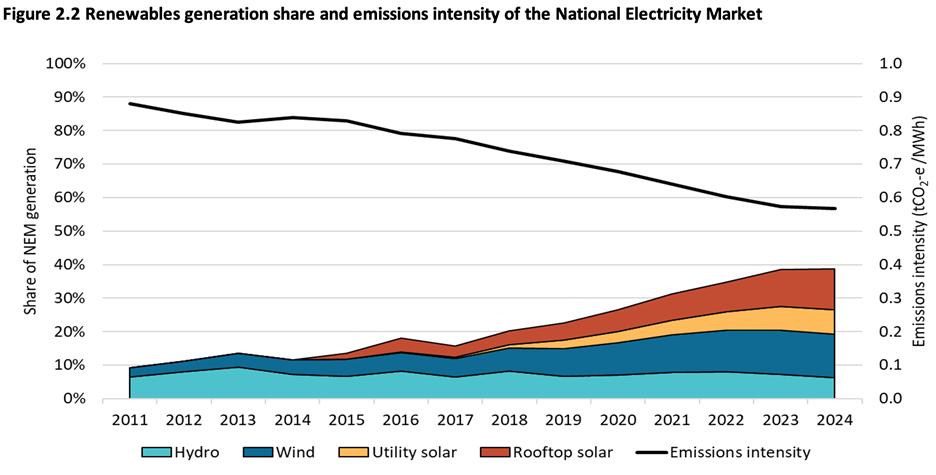
After steady growth, the renewable share (~39% in 2023) has plateaued amid rising demand. (CER Quarterly Carbon Market Report December Quarter 2024)
Renewable energy provided roughly 39% of Australia’s electricity in 2023 (up from just 17% in 2017). But in 2024 this momentum has stalled as electricity demand continues to climb. Simply put, the pace of renewable deployment is not yet on track to hit our targets, despite a strong investor appetite.
Renewables Investment: High Ambition, Slow Delivery
Significant investment is pouring into new generation. The Australian Energy Market Operator (AEMOAEMO, also known as an Australian Energy Market Operator. Is a body that manages electricity and gas systems and markets across Australia. Helping to ensure Australian's have access to affordable, secure and reliable energy.) reported in the December 2024 quarter the energy pipeline continues momentum for large scale solar and wind projects:
- Approvals: 20 projects (~4.9 GW) gained connection approval in Q4 2024
- Grid-registered: 11 projects (~1.7 GW) were fully registered (ready to generate)
- Operational: Only 4 projects (~0.6 GW) reached full output during the quarter
This “connections scorecard” underscores the bottleneck between projects being planned and projects actually delivering energy.
Furthermore, the Federal Government’s Capacity Investment Scheme (CIS) is driving even more capacity (and a lower LGCLarge-scale Generation Certificate under the Australian Renewable Energy Target. More price). In December 2024 under the first tender DCCEWW announced:
- Tenders awarded: 19 new large-scale renewable projects (6.4 GW combined).
This is a tremendous boost – enough to power ~3 million homes – the pipeline of projects is clearly not the problem; the real issue is converting this pipeline into electrons on the grid.
Grid Bottlenecks: Large Energy Users Left Waiting
While utility-scale wind and solar farms grab headlines, large energy users attempting to deploy their own clean and electrification energy projects are hitting the same wall. Northmore Gordon works with dozens of large energy users – from meat processing plants and dairy factories to cold storage facilities, industrial laundries, and food & beverage manufacturers – and many are facing 12 – 36 month delays to connect new renewable generation or behind-the-meter electrification projects. Even when businesses are eager to invest in on-site solar, electrification, or bioenergy, they often wait 1 – 3 years for the network to catch up. These delays impose real costs and slow down emissions reduction in sectors ready to decarbonise.
In 2024, on behalf of our customers, Northmore Gordon undertook 20 electrification studies (converting fossil-fueled equipment to electric alternatives), and these exposed two systemic barriers:
- Grid capacity constraints: Many industrial sites simply don’t have the local grid capacity for significant new loads or generation. Businesses looking to electrify boilers, install large electric compressors, or add several megawatts of solar panels often discover the nearest substation or feeder is at its limit. Frustratingly, businesses are being told to wait 2–4 years for expensive network upgrades before they can fully transition to clean energy.
- Misaligned tariffs: Current network tariff structures do little to encourage using electricity when it’s cheapest and greenest. In today’s market, solar power is abundant at midday – often causing negative prices, and grid stability issues – yet many large users see no substantial bill savings for shifting consumption to daytime hours. Demand charges and flat network tariffs mean there is limited incentive to tap into cheap daytime solar.
These two issues derail the business case for electrification and battery storage in many of our studies. The economic reward for using or storing midday renewable energy is weak under present tariffs and connections will take too long.
Rewiring the Nation: A Call to Action for DNSPs and Government
Australia’s clean energy transition will not succeed without proactive support from the grid itself. Distributed Network Service Providers (DNSPs) – our power distribution companies – must become enablers of the transition for large energy users – some are – but most are not. These companies oversee the “poles and wires” in each region, and they need the right incentives and regulatory direction to act in the public interest. We urge DNSPs to work closely with industry and streamline the connection process for big customers. Fast-tracking assessments, investing in necessary local upgrades, and providing transparency on capacity constraints are ways DNSPs can directly help.
Meanwhile, the Federal Government has a powerful lever in its $20 billion Rewiring the Nation fund. This initiative needs to further align policy and investment with the needs of large energy users and renewable developers alike. We call on government to deploy Rewiring the Nation capital and policy support toward four critical priorities:
- Grid capacity upgrades: Accelerate upgrades of network capacity in renewable-rich regions and industrial zones, so both new solar/wind farms and electrified factories can connect without multi-year delays.
- Faster connections: Streamline grid connection approvals and technical studies for large energy users’ projects. Set clear timelines and accountability for DNSPs to deliver connections, shrinking the 2–4 year wait times to months instead.
- Tariff reform: Overhaul network tariffs to reward consumers for using power when it is cheapest and cleanest. By incentivising use of daytime solar, businesses will shift loads to soak up excess solar generation – cutting emissions and power costs and helping grid utilization simultaneously.
- Support for behind-the-meter projects: Provide targeted funding or incentives for on-site generation and storage at commercial and industrial sites. Behind the meter electrification, renewable and storage, with the right tariffs, will reduce strain on the grid and accelerate emissions cuts in hard-to-abate sectors.
Australia’s 2030 targets are bold and achievable, but only if we match ambition with action
Large energy users are ready to invest in clean energy and be part of the solution. It’s now up to our network providers and governments to clear the path – by rewiring the nation’s grid, reforming tariffs, and removing bottlenecks – so that 82% renewables (and beyond) can become a reality. The time for bold, collaborative action is now, to ensure Australia’s energy transition stays on track and delivers benefits for all.
Contact us today to continue the conversation.
Disclaimer: The information in this article is general only and has been prepared without considering your business’ particular circumstances and needs. You should assess or seek advice from Northmore Gordon Environmental (AFSL 533927) on whether it is appropriate for your business’s objectives.