
An update from the NG trading desk: the Safeguard Mechanism and markets
The Australian Government’s Safeguard Mechanism is a federal policy aimed at reducing emissions from Australia’s largest industrial facilities.
Key messages
- The largest 215 facilities in Australia, emitting over 100 ktCO2-e p.a., fall under the Safeguard Mechanism.
- These sites must reduce emissions by 4.9% p.a. or surrender ACCUs or SMCs.
- Sites that reduce emissions beyond 4.9% p.a. can register SMCs and trade them.
- The Safeguard site represents the largest potential demand for ACCUs, and the quantity of SMCs registered has a direct impact on ACCUAn ACCU is a unit issued to a person by the Clean Energy Regulator (Regulator) by making an entry for the unit in an account kept by the person in the electronic [Australian National Registry of Emissions Units] registry. Each ACCU issued represents one tonne of carbon dioxide equivalent (tCO2-e) stored or avoided by a project. An ACCU can only be issued to a person if the person has a Registry account. prices.
Obligations Under the Safeguard Mechanism
Facilities emitting over 100,000 tCO2-e (Tonnes of CO2 equivalent) must operate within specific emissions baselines and to reduce these emissions by 4.9% p.a. in line with 43% reduction (on 2005 levels by 2030) and net zero by 2050.
In 2023-24, total emissions from the 215 safeguard facilities were approximately 136 MtCO2-e, down from 138.7 MtCO2-e in 2022-23.
Managing Emissions: SMCs and ACCUs
Facilities that emit below their declining baselines can earn Safeguard Mechanism Credits (SMCs), which can be sold to other entities or banked for future compliance needs. Whilst facilities exceeding their baselines must offset the excess emissions either by surrendering SMCs or Australian Carbon CreditA certificate that is equivalent to 1 tonne CO2-e. Credits often refer to instruments issued under a cap and trade scheme, where companies are allocated credits up to their emission cap. If they exceed the cap they need to purchase more credits. Units (ACCUs).
Trading SMCs and ACCUs: Supply and Demand
Following the 2024 reporting period
- Supply: over 8 million SMC units have been issued to 57 facilities. This was much higher than anticipated.
- Demand: the CER estimates that excess emissions from 144 facilities will require 9.2 MtCO2-e surrendered either from SMCs or ACCUs
The market had expected a much lower number of SMCs to be issued and hence much more of the existing 50M in ACCU holdings to be consumed in the first year of surrender under the revamped Safeguard mechanism.
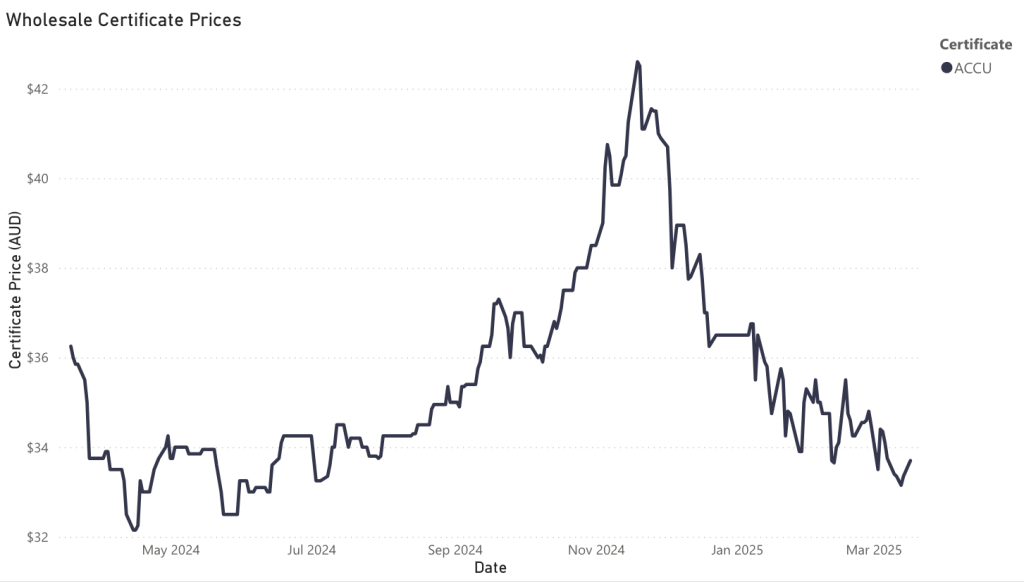
In early March, Core Markets reported that SMCs commenced trading in the brokered markets, and at a slight discount of $0.50 to $1.00 to the ACCU price ($33.25), presumably this reflects that SMCs can only be used for Safeguard sites.
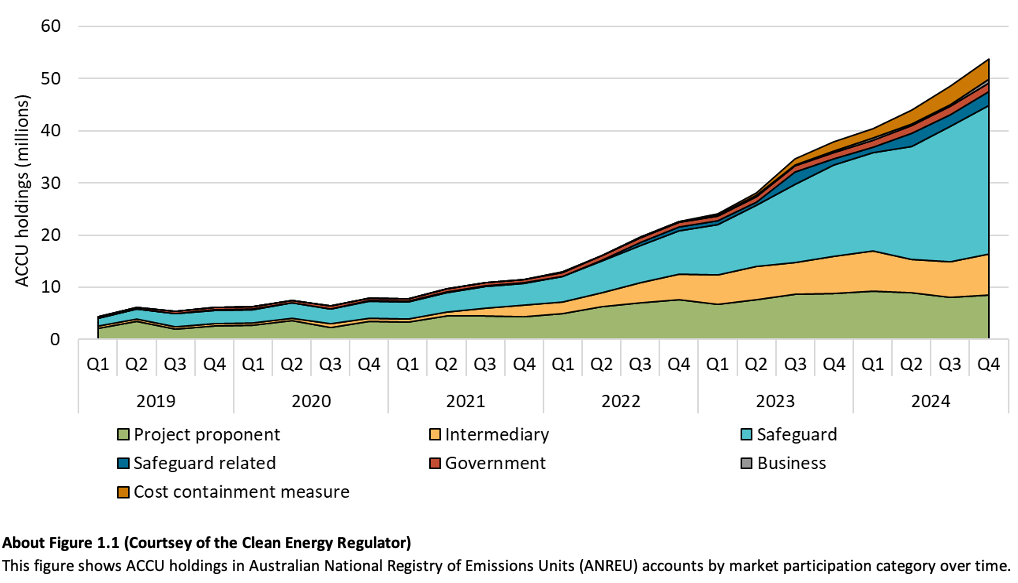
In preparation for the Safeguard Mechanism we can see that over 50% of the ACCUs in holding accounts are being retained by Safeguard sites.
Impact on ACCU Prices
The introduction and trading of SMCs influences the ACCU market. An increase in SMC availability can lead to a reduced demand for ACCUs, potentially stabilising or lowering their market price. Conversely, if fewer SMCs are issued than anticipated, facilities may turn to ACCUs to meet compliance, thereby driving up prices. In late 2024 the ACCU price rose substantially, likely in anticipating of the increased demand under the Safeguard. However, with the large number of SMCs being issued for sites being under their baseline emissions, the ACCU prices retreated to prices similar to mid 2024.
Distinguishing Between SMCs and ACCUs
While both SMCs and ACCUs serve as instruments to offset emissions, their origins differ. SMCs are exclusive to the Safeguard Mechanism, awarded to facilities that operate below their emissions baselines. In contrast, ACCUs are generated from a broader range of projects, including land-based carbon sequestration and energy efficiency initiatives. Facilities under the Safeguard Mechanism can utilize either SMCs or ACCUs to meet their compliance obligations.
Forecast and Registration of SMCs
The Clean Energy RegulatorThe Clean Energy Regulator is the Australia Government body responsible for accelerating carbon abatement for Australia through the administration of the National Greenhouse and Energy Reporting scheme, Renewable Energy Target and the Emissions Reduction Fund. More (CER) had projected the issuance of SMCs based on anticipated emissions performances. However, the actual number of SMCs registered can vary due to factors such as operational changes and emissions reduction initiatives implemented by facilities. Detailed statistics on the forecasted versus actual SMC registrations for the December Quarter 2024 are available in the CER’s Quarterly Carbon Market Report.
Cost Containment Mechanism
To prevent excessive compliance costs, the Safeguard Mechanism incorporates a Cost Containment Measure. This mechanism ensures that ACCU prices remain within a manageable range, providing price predictability for facilities. The CER sources ACCUs for this purpose from various channels, including those delivered under Commonwealth carbon abatement contracts. One source for the CCM is that those exiting their ERFThe Emissions Reduction Fund is a voluntary scheme that aims to provide incentives for a range of organisations and individuals to adopt new practices and technologies to reduce their emissions. contracts (through a mechanism known as the “buyers damages” clause) must still deliver 20% of the contracted volume to government at the auction price from their agreement.
Implications for Facilities and ACCU Market Dynamics
Facilities regulated under the Safeguard Mechanism must proactively manage their emissions to stay within declining baselines. This necessitates investing in emissions reduction technologies or securing sufficient credits (SMCs or ACCUs) for compliance. The interplay between SMC issuance and ACCU demand is crucial; a shortfall in SMCs can heighten ACCU demand, influencing market prices.
In summary, the Safeguard Mechanism plays a critical role in steering Australia’s industrial sector towards sustainable practices. Understanding the nuances of SMCs, ACCUs, and their market implications is essential for facilities to navigate compliance effectively and contribute to national emissions reduction goals.
Take “direct action” with Northmore Gordon
Looking for energy efficiency or decarbonisation projects? Need expert guidance on your ACCU and SMC strategy? Whether you’re looking to secure forward contracts, explore energy-saving opportunities, or navigate compliance requirements, Northmore Gordon can help.
Consider not only your carbon strategy, but also renewable energy and energy efficiency to maximise the value from environmental attribute certificates.
Disclaimer: The information in this article is general only and has been prepared without considering your business’ particular circumstances and needs. You should assess or seek advice from Northmore Gordon Environmental (AFSL 533927) on whether it is appropriate for your business’s objectives.