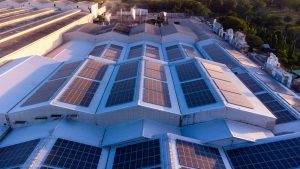

The Victoria Energy Policy Centre (VEPC) is advocating for a groundbreaking policy shift to promote large-scale rooftop solar systems paired with batteries on Australia’s commercial and industrial (C&I) properties. This initiative, detailed in VEPC’s latest discussion paper, seeks to not only provide businesses with self-sustaining energy solutions but also enable them to export surplus power back to the grid during peak demand periods, offering a new revenue stream for businesses while supporting the broader energy market. The big question is, will this happen in 2024-2025?
Madonna Ghajar, from Northmore Gordon remarked on the initiative, stating, “This initiative represents a crucial step toward a more sustainable future by harnessing the untapped potential of C&I rooftops. Integrating large-scale rooftop solar and battery systems not only provides Victorian businesses with a new revenue stream but also supports the broader energy market, aligning perfectly with Northmore Gordon’s commitment to advancing emission-free electricity through innovative solutions.”
Transforming Rooftops into Powerhouses
The discussion paper, titled “Business Power,” emphasizes the untapped potential of C&I rooftops across Australia, arguing that these spaces could be converted into substantial electricity generation and storage assets. VEPC’s calculations suggest that the country’s unused rooftop space is vast enough to supply at least 25% of Australia’s annual electricity needs, potentially transforming the national energy landscape.
VEPC Director Bruce Mountain underscored the transformative impact of this policy shift: “Electricity produced in cities and used locally reduces transmission losses. Businesses could generate solar power during the day, store it in batteries, and sell it back to the grid during peak hours.”
Financial Incentives for a Sustainable Future
To make this vision financially viable, VEPC proposes the introduction of new floor prices for electricity sold to the grid outside peak solar periods and for battery discharge during evening peaks. Specifically, the paper suggests a solar feed-in floor price of $100 per MWh and a battery discharge floor price of $200 per MWh. These incentives aim to make investing in rooftop solar and battery storage an attractive proposition for businesses, thereby accelerating the transition to a low-carbon economy.
This policy framework aligns with Northmore Gordon’s findings that solar with battery energy storage systems (BESS) generate additional value under the Victorian Energy Upgrades scheme when reducing excess export to the grid. Northmore Gordon recommends that the Victorian Government explorers ways to increase VEEC generation for Solar with batters under the VEU. Supporting battery storage not only enhances grid stability but also improves cost efficiency, aligning with the broader goal of expanding emission-free electricity while minimizing the need for costly new transmission infrastructure.
Bridging the C&I Solar Gap
While residential solar adoption has surged in recent years, the uptake in the C&I sector has lagged. Between 2019 and 2023, residential rooftop solar capacity grew by approximately 2.5 GW annually, whereas the C&I sector added only about 500 MW per year. This discrepancy highlights a significant opportunity for growth in the commercial sector, which VEPC’s proposed policies aim to address.
A recent report by Victoria-based research firm Nexa Advisory further supports VEPC’s findings, estimating that an additional 28 GW of rooftop PV could be installed across C&I rooftops within the National Electricity Market. This expansion could play a crucial role in replacing coal generation set to be phased out over the next decade, all while minimizing the environmental and social impacts associated with large-scale solar and wind projects that require extensive new transmission infrastructure.
Mountain also pointed out that this shift could reduce the reliance on large-scale solar and wind farms located in rural areas, which require expensive new transmission lines to deliver power to urban centers. Instead, locally produced and stored energy could make better use of existing urban distribution networks, enhancing the efficiency of the energy system.
A Vision for the Future
The VEPC’s “Business Power” proposal is driven by the urgent need to expand emission-free electricity sources in Australia. As the country prepares for the closure of coal-fired power stations, this policy could play a pivotal role in ensuring a smooth transition to cleaner energy. By tapping into the potential of C&I rooftops, Australia could not only meet a significant portion of its electricity needs with renewable energy but also do so in a way that minimizes the social and environmental costs associated with traditional energy infrastructure projects.
Mountain concluded with a compelling vision: “In short, there seems to be little to be lost and a potentially large benefit to society.”
As Australia continues to lead the world in solar adoption, this policy shift could position the country as a global leader in integrating battery-backed solar solutions into the commercial sector, paving the way for a more sustainable and resilient energy future.