
Starting in January 2025 the Australian Government’s new mandatory climate-related financial disclosures will take effect. This marks a significant step toward mitigating climate risk and opens up new opportunities in decarbonizing markets. Organisations need to understand these new disclosure requirements and start preparing now, they should look beyond reporting and integrate projects, that will reduce emissions and provide a payback through environmental certificates and grants.
Key Updates:
Global Context: At COP28 (Nov-Dec 2023), the International Sustainability Standards Board (ISSB) took over climate-related financial reporting responsibilities from the Task Force on Climate-related Financial Disclosures (TCFDThe Task Force on Climate-related Financial Disclosures (TCFD) is an industry-led effort, chaired by Michael Bloomberg, with 32 global expert members from the private sector. The TCFD recommendations are designed to solicit consistent, decision-useful, forward-looking information on the material financial impacts of climate-related risks and opportunities, including those related to the global transition to a lower-carbon economy. More), now disbanded. This shift signifies a major uplift in climate-related practices globally, with Australia introducing its own MCR system, which includes over 100 disclosures—far more than TCFD’s 11.
Rollout: Starting with Group 1 in FY 2025/26, Australia’s mandatory climate reporting will be phased in, covering companies with over 500 employees, followed by Group 2 in FY 2026/27 for companies with more than 250 employees, and finally, Group 3 in FY 2027/28 for those with over 100 employees. This rollout will apply to organizations based on their gross assets, revenue, and employee count, ensuring comprehensive climate-related financial disclosures.
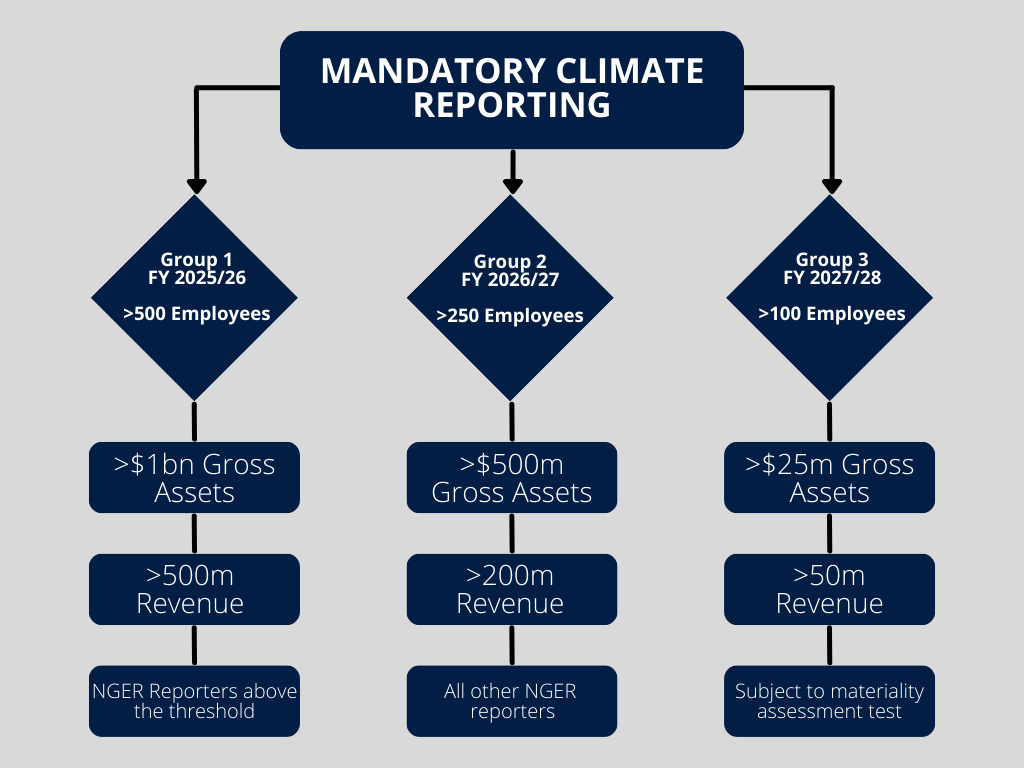
Applicability: MCR laws will apply to most public companies and may extend to larger NFPs, private entities, and government bodies.
Liability: Treasury will limit Directors’ liability during the first three years of implementation for Scope 3 emissions and certain climate-related forward-looking statements.
Why is MCR introduced?
A robust, internationally consistent, and credible climate disclosure framework will enhance Australia’s reputation as an appealing destination for global capital, attracting the necessary investments for the transition to net zero.
What is to be reported?
Climate-related financial disclosures will encompass details on an entity’s climate-related risks and opportunities, as mandated by Australian climate disclosure standards, including:
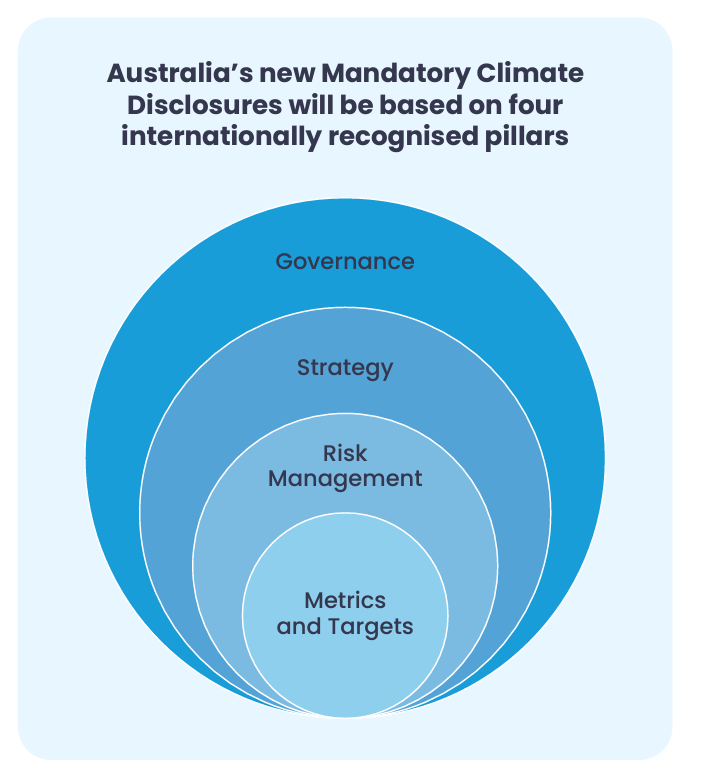
- From the first reporting year, entities must provide information on governance, strategy, risk management, metrics, and targets, including Scope 1 and Scope 2 greenhouse gas emissions.
- From the second reporting year, entities will be required to disclose Scope 3 emissions, which include emissions occurring throughout their supply chain and those associated with their financing or investment activities. Scope 3 disclosures will be based on information available at the reporting date without incurring excessive costs or effort.
Where/How should I report Climate-related financial disclosures?
Climate-related financial disclosures will be included within your sustainability report, serving as the fourth required document under annual financial reporting obligations and incorporated into an entity’s annual report. To assist users in easily locating climate disclosures, entities should provide an index table within their annual reports. The submission timeline for annual reports, including those filed with the Australian Securities and Investment Commission (ASIC), will remain consistent with the existing requirements specified in section 319 of the Corporations Act.
These news laws place increased workload on finance and accounting teams, but critical to ensuring these compliance requirements become a benefit (not a cost) is examining capital projects through the lens of energy efficiency, emissions reduction, and the role environmental attribute certificates play. Assessing and undertaking electrification projects, equipment upgrades, and improving production efficiency requires detailed technical understanding. The right projects have a return on investment and pay you to reduce emissions. Northmore Gordon, do more with less energy, and less carbon.
Steps you can start doing now
- Executive workshop and preparedness
- Baseline your carbon footprint (Scope 1, 2 and 3)
- Energy Audits to understand opportunities
- Net Zero Roadmap including the technical solutions for real action
- Environmental Certificates for renewable energy or project payback
Prepare now to stay ahead. Explore our Mandatory Climate Reporting Services and ensure your organization is ready for these crucial changes.
For more information, check out the Australian Sustainability Reporting Standards and Treasury’s Mandatory Climate-related Financial Disclosures.